

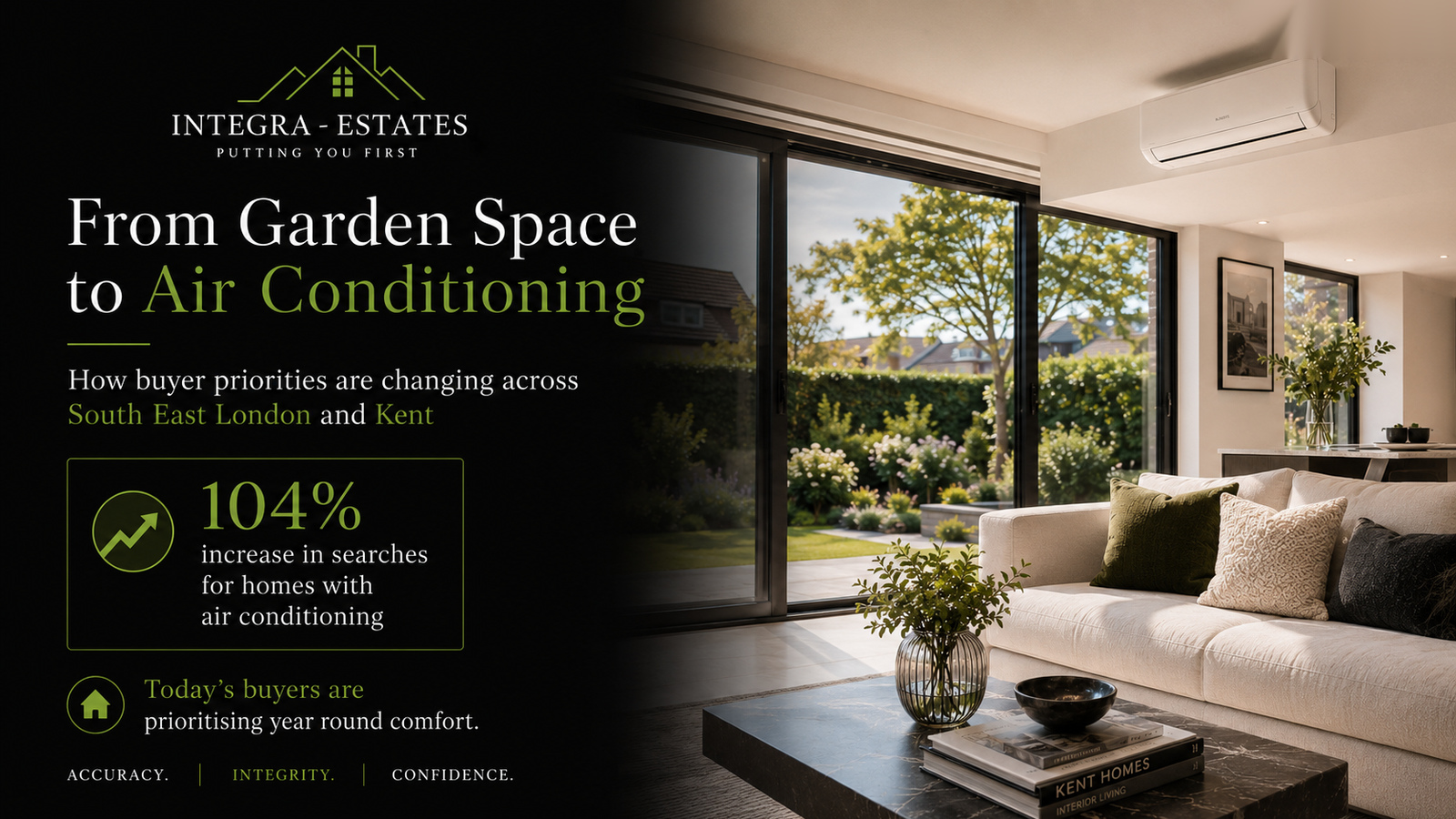
From Garden Space to Air Conditioning: How Hotter Summers Are Changing Buyer Priorities Across South East London and Kent
From Garden Space to Air Conditioning: How Hotter Summers Are Changing Buyer Priorities Across South East London and Kent
At two o’clock in the morning, when a bedroom is still holding the heat of the day, air conditioning does not feel like an unnecessary luxury.
It feels like the possibility of a proper night’s sleep.
That simple change in perspective helps to explain why air conditioning is appearing more frequently in property searches across the United Kingdom.
For generations, British buyers have understandably concentrated on location, price, space, transport connections and access to good schools. Those priorities have not disappeared. However, repeated periods of extreme heat are encouraging people to consider another important question.
How comfortable will this property be when the temperature outside rises above 30 degrees?
It is a question that may once have seemed unusual during a British property viewing. Today, it is becoming increasingly relevant, particularly across South East London and Kent.
This is not simply a story about buyers wanting another appliance. It is a story about how lived experiences can change the way people choose their next home.
Property wish lists change when everyday life changes
We have seen buyer priorities shift before.
During the Covid 19 lockdowns, millions of people suddenly spent far more time at home. Living rooms became offices. Kitchen tables became classrooms. Spare bedrooms became permanent workspaces. Gardens and balconies offered a welcome sense of freedom.
Features that had previously been regarded as desirable suddenly became far more important.
Rightmove reported that searches by buyers for homes with gardens were 42 per cent higher in May 2020 than in May 2019. Searches by renters rose by 84 per cent. More than one third of buyers said lockdown had changed what they wanted from their next home.
The garden itself had not changed.
What changed was the buyer’s understanding of its value.
Before lockdown, a garden may have been viewed primarily as somewhere to enjoy a summer barbecue or spend an occasional Sunday afternoon. During lockdown, it became a place to exercise, work, play, relax and find a little space away from the same four walls.
Experience transformed a preference into a priority.
We may now be seeing a similar process with summer comfort.
The comparison is not intended to suggest that the pandemic and extreme summer temperatures are equivalent events. They are clearly very different. The similarity lies in the way an external event can expose a weakness within someone’s existing home and influence what they look for next.
A buyer who has struggled to sleep through several nights of intense heat may approach their next property search differently.
A parent who has been unable to keep a child’s bedroom comfortable may pay closer attention to room orientation, ventilation and cooling.
Someone working from a loft conversion or home office may now wonder whether the space will remain usable throughout the summer.
The experience creates the concern.
The concern then appears in the property search.
Searches for homes with air conditioning have more than doubled
Between 1 May and 31 July 2026, Rightmove recorded a 104 per cent annual increase in searches for homes for sale with air conditioning.
Rightmove’s accompanying consumer research found that 87 per cent of people considered a property’s ability to remain cool important when choosing their next home.
Although only 12 per cent of respondents had already installed air conditioning, 61 per cent said they would consider doing so.
Only 11 per cent believed their present home remained very comfortable during hot weather, while 45 per cent said their property struggled to stay cool.
Those figures reveal something more meaningful than a passing interest in air conditioning.
Nearly nine in ten people are not necessarily demanding a conventional air conditioning system in every room. They are saying that summer comfort now matters when choosing a home.
That is a broader and potentially more significant change.
A buyer may be attracted to air conditioning, but they may also be considering effective ventilation, natural shade, the amount of glazing, the direction rooms face and the likely cost of keeping the property comfortable.
Air conditioning is the visible search term.
The deeper requirement is control over the indoor environment.
This is not the first time buyers have searched for cooler homes
The latest figures do not represent the first major rise in interest.
During July and the first two weeks of August 2022, searches for homes for sale with air conditioning increased by 234 per cent compared with the corresponding period in 2021.
On 19 July 2022, when temperatures exceeded 40 degrees in the United Kingdom for the first time, searches for homes to buy with air conditioning rose by 280 per cent compared with the same date a year earlier.
Despite that sudden increase, fewer than one per cent of the available properties for sale or rent mentioned air conditioning at the time.
Rightmove also found that agents were making greater use of terms such as ceiling fan, shade, awning, breeze and light and airy when describing properties.
The 2022 and 2026 percentages should not be treated as one continuous statistical series because the measurement periods are different.
They do, however, tell a consistent story.
Interest rose dramatically during the exceptional heat of 2022. Four years later, searches have again increased substantially as buyers experience further periods of unusually warm weather.
This makes it increasingly difficult to dismiss air conditioning as a brief or isolated property trend.
The human experience behind the search data
Property search figures can sometimes feel abstract.
The latest evidence about overheating helps us understand the human experience driving this particular trend.
Research published by Citizens Advice in August 2026 found that 44 per cent of people felt they had very little control or no control over the temperature of their home during a heatwave.
One in six adults had taken more drastic action to escape the heat. This included sleeping in kitchens, bathrooms, gardens, balconies or vehicles, taking time away from work, or paying for temporary accommodation with air conditioning.
Citizens Advice also found that building design, the cost of purchasing cooling equipment and the cost of running fans or air conditioning were among the principal barriers preventing people from keeping their homes comfortable.
This gives the Rightmove search figures important context.
People are not searching for air conditioning merely because it sounds impressive in a property description.
They are searching because they remember lying awake in an overheated bedroom.
They remember attempting to work while every room felt uncomfortable.
They remember moving fans around the home, covering windows and trying to find somewhere cooler to sleep.
When that experience is repeated, it can become part of the next moving decision.
Global warming is becoming part of the property conversation
Global warming can sometimes feel like an abstract or distant subject.
For property buyers, however, its effects become much more tangible when they influence the comfort of a bedroom, the usability of a home office or the ability to relax inside during the hottest part of the day.
The Met Office reports that the most recent ten year period, from 2016 to 2025, was 1.33 degrees Celsius warmer across the United Kingdom than the period from 1961 to 1990.
The number of days above 30 degrees Celsius and nights above 18 degrees Celsius more than quadrupled in Greater London during that recent decade.
The average hottest day of the year also warmed by more than 4.5 degrees Celsius across a broad area extending from Kent to Lincolnshire.
These are measured changes rather than distant predictions.
They help to explain why buyers across South East London and Kent are becoming more conscious of how a property performs during prolonged periods of warmth.
People are still considering how efficiently a property can retain heat in winter. Increasingly, they are also asking whether it can release heat and remain comfortable in summer.
Buyers are searching for comfort, not simply a machine
Air conditioning is easy to understand and easy to enter into a property search.
The underlying requirement is more nuanced.
A buyer may not insist on a wall mounted air conditioning unit. They may simply want reassurance that their next home will remain comfortable throughout the year.
That may depend on the orientation of the property, the position of the bedrooms, the size and direction of the windows, the amount of natural shade and whether air can move effectively through the accommodation.
A living room with windows on more than one side may benefit from stronger natural ventilation.
Mature trees can provide valuable shade.
Shutters, blinds or external awnings may help reduce the amount of direct sunlight entering through large windows.
A well positioned bedroom may remain naturally cooler than one receiving intense afternoon or evening sun.
A traditional home with substantial walls and generous ceiling heights may behave differently from a modern apartment with extensive glazing.
None of these examples means that one style or age of property is automatically better than another.
A Victorian house can overheat. A contemporary apartment can remain comfortable. A recently built home can struggle with excessive solar gain, while an older property may benefit from thoughtful orientation and natural airflow.
How the individual property has been designed, altered and maintained matters more than a simple distinction between old and new.
The important point is that buyers are becoming more aware of these differences.
Why this matters across South East London and Kent
The areas served by Integra Estates contain an exceptionally varied collection of homes.
There are Victorian and Edwardian houses throughout Catford, Hither Green, Sydenham and Penge. Beckenham, Bickley and Bromley offer everything from period family homes to contemporary apartments. Orpington and the surrounding parts of Kent contain traditional houses, modern developments, converted properties and homes with generous gardens.
Each type of property can respond differently to periods of extreme warmth.
A top floor conversion in Sydenham may present different questions from a family home in Beckenham.
A contemporary apartment with large windows in Bromley may need to be considered differently from a traditional house in Catford with windows at both the front and rear.
A loft bedroom may look impressive and provide valuable additional space, but a buyer may now ask how it feels during a heatwave.
A south facing garden may remain extremely desirable, while also encouraging a buyer to consider how much direct sunlight enters the rear of the property.
Large windows can fill a room with natural light, but buyers may also want to understand whether the glazing, shading and ventilation help to manage the temperature.
These are not reasons to criticise a property.
They are examples of buyers becoming more thoughtful about how a home performs under different conditions.
The property wish list is becoming more sophisticated.
Is air conditioning becoming the new garden?
Not exactly.
Gardens have a broad and enduring appeal. They provide room for children, pets, entertaining, gardening, home working and relaxation. Outdoor space can influence daily life throughout the year.
Air conditioning remains far less common in British homes and will not become essential to every buyer.
The comparison is therefore not about air conditioning replacing the garden or becoming equally important in every property search.
It is about how buyer priorities are formed.
Before lockdown, many people already wanted a garden. Lockdown made them understand more clearly why they wanted one.
Before repeated heatwaves, most people appreciated a cool bedroom. Experiencing extreme temperatures made them understand how significantly that comfort could affect sleep, work and general wellbeing.
The feature may be different, but the behavioural pattern is similar.
A significant lived experience changes what people notice about their present home. That experience then influences the next property search.
Buyers are judging homes across all four seasons
For many years, energy efficiency in British housing has been discussed mainly in relation to winter.
Can the home retain warmth?
How expensive will it be to heat?
Does it have suitable glazing and insulation?
Those questions remain extremely important.
However, buyers are now becoming more aware that a comfortable and efficient property must also perform during summer.
The emerging ideal is a home that works throughout the year.
Warm during winter.
Comfortable during summer.
Light without becoming oppressive.
Well ventilated without feeling cold or draughty.
Efficient without becoming unreasonably expensive to operate.
This is why air conditioning should be understood as part of a wider conversation about year round liveability.
The property industry may describe the issue as thermal comfort. Most buyers will express it more simply.
They want to know whether they will be able to sleep, work and relax comfortably in their own home.
Air conditioning is not the only answer
Rising interest in air conditioning does not mean every homeowner should immediately arrange an installation.
Running costs, energy use, noise, maintenance, positioning and the appearance of the system all need careful consideration.
For some homes, air conditioning may provide an effective solution. In others, improved ventilation, external shading, appropriate window coverings, planting or changes to how particular rooms are used may prove more suitable.
The Climate Change Committee reported in May 2026 that, without sufficient adaptation, 92 per cent of existing homes could be at risk of overheating by 2050.
Its recommendations include better cooling, heat pumps and green shading as part of the wider response to increasing heat.
The most important change is therefore not simply greater demand for one particular piece of equipment.
It is a growing expectation that homes should be capable of remaining comfortable in a changing climate.
What does this change mean for property sellers?
The first lesson is that meaningful property features should never be overlooked within the marketing.
Where a home has fixed air conditioning, the property description should explain this clearly and accurately.
It should identify the rooms that benefit and help prospective buyers understand how the system contributes to the use and comfort of the home.
It should not be reduced to an unexplained reference near the end of a long list of features.
At the same time, sellers should not assume their home has nothing relevant to offer simply because it does not have air conditioning.
Natural ventilation, established shade, shutters, ceiling fans, generous ceiling heights and thoughtful room orientation may all contribute to summer comfort.
These qualities should be presented honestly and without unsupported claims.
A property should never be described as remaining cool throughout the summer unless there is a reasonable basis for saying so.
Effective marketing is not about attaching fashionable phrases to a listing.
It is about identifying genuine advantages and explaining why they matter.
Good property marketing should explain how a home feels
Professional photography can show window proportions, ceiling height, shutters, mature planting and shaded outdoor areas.
A carefully prepared floor plan can help a buyer understand whether the accommodation benefits from windows on more than one side.
A property video can demonstrate how the rooms connect.
A fully interactive 360 degree tour can allow a buyer to explore the layout in greater detail before arranging a viewing.
These tools become more valuable when they are used to communicate how a property functions, rather than simply recording what it contains.
A beautifully photographed bedroom may attract attention.
A considered description explaining that the room is positioned away from the strongest afternoon sun can add meaningful context.
A picture of an established garden may look appealing.
Showing how mature planting provides shade close to the house can help a buyer understand an additional practical benefit.
Exceptional property marketing connects the physical feature with the experience it creates.
Will air conditioning add value to a property?
There is no reliable basis for claiming that air conditioning will automatically add a particular amount to the value of every home.
Property value depends on location, size, condition, tenure, buyer competition, installation quality and the wider market.
A discreet and efficient system serving important rooms may be attractive to buyers.
An older, noisy or poorly positioned installation may be viewed differently.
Running costs may also matter. Buyers are becoming increasingly aware of both summer comfort and household expenditure. A cooling system that appears expensive to operate may create as many questions as it answers.
The more responsible conclusion is that air conditioning can improve marketability where it meets a genuine buyer requirement.
It may attract additional interest.
It may encourage someone to arrange a viewing.
It may distinguish one property from another.
It may become particularly persuasive to a buyer who has struggled with overheating in their present home.
That is not the same as guaranteeing a price premium.
Marketability and valuation are connected, but they are not interchangeable.
Property marketing must move with the buyer
The strongest property marketing reflects the way people are living now.
During the pandemic, agents needed to give greater prominence to gardens, balconies, home offices and flexible living space.
Following repeated periods of extreme heat, sellers and agents should pay closer attention to air conditioning, ventilation, shade, glazing and year round comfort.
This does not mean chasing every temporary trend.
It means recognising when a change in buyer behaviour is supported by both search evidence and everyday experience.
The Rightmove findings from 2022 showed the first dramatic rise in interest.
The 2026 data suggests the subject has not disappeared.
The research from Citizens Advice demonstrates the discomfort driving that interest.
The Met Office evidence explains why the issue is particularly relevant across Greater London and Kent.
Taken together, the evidence points towards a meaningful change.
Buyers are no longer considering only how a property looks.
They are considering how it will feel to live there.
Frequently asked questions about homes with air conditioning
Are more buyers searching for homes with air conditioning?
Yes. Rightmove reported that searches for homes for sale with air conditioning rose by 104 per cent between 1 May and 31 July 2026 compared with the same period in 2025.
The figures suggest that hotter summers are encouraging buyers to pay closer attention to how comfortable a property will remain during periods of extreme heat.
Is air conditioning now essential when selling a property?
No. Location, price, space, condition and affordability remain central to most property decisions.
However, air conditioning may be a valuable point of difference where it is already installed, particularly in bedrooms, living areas, loft conversions or properties with extensive glazing.
Homes without air conditioning may still benefit from natural ventilation, effective shading, thoughtful orientation and other features that help manage summer temperatures.
Can air conditioning increase the value of a home?
Air conditioning does not guarantee a particular increase in value.
A well designed and properly maintained system may improve the appeal and marketability of a property, but buyers will also consider its age, efficiency, appearance, noise and likely running costs.
Its effect will depend on the individual home and the buyers competing for it.
Which homes are most likely to become uncomfortably warm?
Any property can overheat under the right conditions.
Upper floor rooms, loft conversions, homes with large areas of glazing and properties receiving prolonged direct sunlight may require particular consideration.
Room orientation, ventilation, external shading, surrounding trees and the design of the building can all influence how comfortable it remains.
How should air conditioning be presented in property marketing?
It should be described clearly and accurately.
The marketing should identify which rooms benefit, whether the system is fixed and how it contributes to the comfort of the property.
Professional photography should show the feature honestly without allowing it to dominate the room unnecessarily.
A home is a collection of future experiences
A buyer is not merely purchasing a number of bedrooms, a floor area and a postcode.
They are purchasing future mornings, evenings, working days, weekends and nights of sleep.
They are imagining breakfast in the kitchen, time in the garden, children settling into bedrooms, quiet evenings in the living room and the ability to work comfortably from home.
Increasingly, they may also be imagining the property during the hottest week of the year.
This is where the comparison with lockdown becomes most meaningful.
After lockdown, buyers searched for homes that allowed them to step outside.
After repeated heatwaves, a growing number are searching for homes in which they can remain comfortably inside.
The property itself may not have changed.
The buyer viewing it has.
Experience the Integra Estates difference
At Integra Estates, we believe exceptional property marketing begins with understanding what buyers genuinely value.
It is not enough to produce an attractive set of photographs and a standard property description.
The marketing must identify the qualities that influence everyday life and communicate them clearly, accurately and persuasively.
Whether your property benefits from air conditioning, natural ventilation, generous ceiling heights, established shade, a beautifully positioned garden or a particularly thoughtful layout, those qualities deserve to be recognised and presented properly.
Our approach combines professional photography, digital photo staging where appropriate, carefully written property descriptions, detailed floor plans, property videos, fully interactive 360 degree tours and Premium Rightmove marketing.
Viewings are conducted by experienced members of our team who understand the property and can communicate its most important qualities properly.
All of this is offered with our no sale, no fee service and zero week agreement, giving our clients exceptional marketing without a lengthy contractual commitment.
To experience the Integra Estates difference, or to have an open and honest conversation about how best to market your property in today’s changing market, please contact our team.
We will take the time to understand your home, identify what makes it compelling and create a marketing strategy around the way real buyers now search, compare and make decisions. Contact us at 0203 870 00 00 E-mail
How much is your property worth?
Get your property valued by a local expert
Get A Valuation
-1.png)
.jpg)
.jpg)
.jpg)


Blogs
Loading photographs…
Let's Talk
If you want to discuss your property, plans for the future, or just want some friendly advice. There'll be no pressure, Just equal measures of common sense and expert advice to point you in the right direction.
Get In Touch