Digital Staging for Beckenham BR3 Sellers: Rules and Limits
Digital Staging for Beckenham BR3 Sellers: Rules and Limits
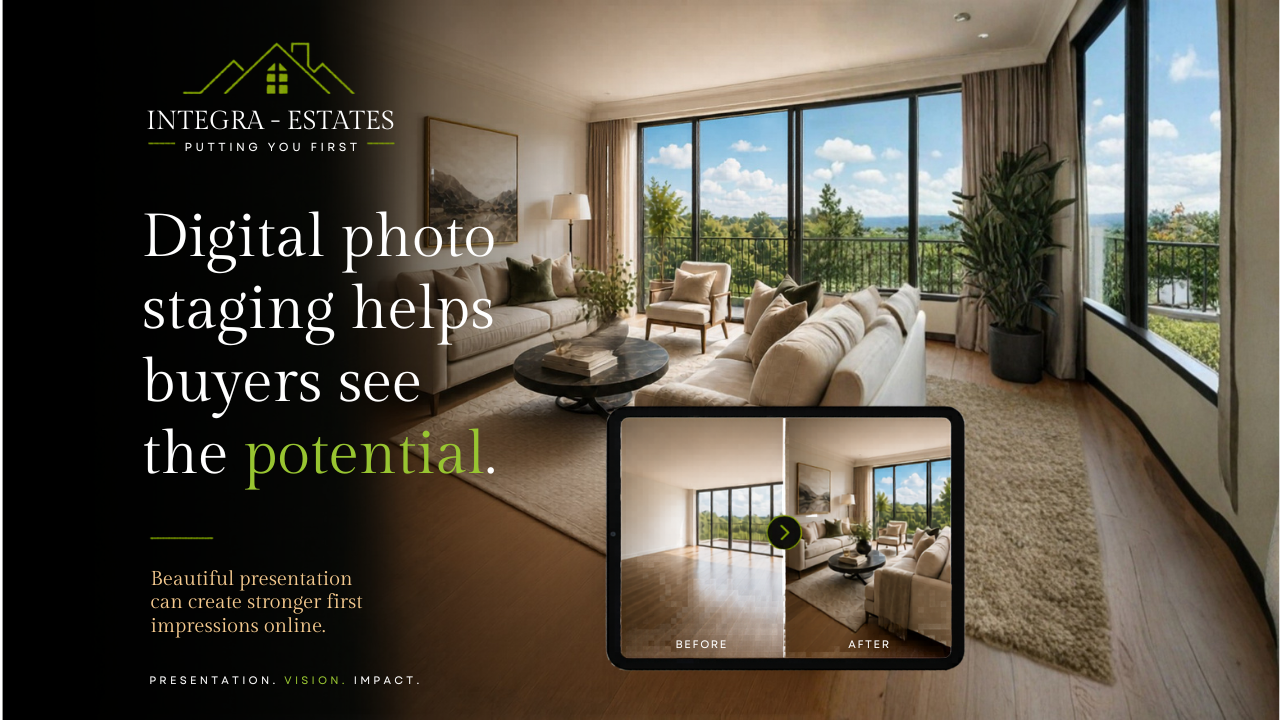
Digital staging, also called virtual staging, is the practice of adding furniture, décor and sometimes finishes to a photograph of an empty or tired room so that a buyer can see what the room could be. Done well, it helps a buyer read an empty probate house or a vacant flat. Done badly, it is a misleading advertisement, and since April 2025 the law on that has sharper teeth than it used to.
This guide explains what the evidence says about listing photographs, where the legal lines are, the labelling standard we apply, when staging helps a Beckenham sale and when it does not. The sources are at the end, and where a statement is our practice rather than a published rule it says so.
What staging is for
Rightmove reported in 2020 that over 70% of its traffic came from mobile phones, where a user sees only the first photograph before deciding whether to tap through. Its 2022 listing analysis found that branches including five or more photographs on their listings received on average 11% more leads, and those including floor plans 12% more. The first photograph and the completeness of the set are what the evidence supports. There is no published UK data comparing staged and unstaged photographs, and we would not claim there is.
What staging does, in our experience, is answer the question an empty room poses: how big is this really, and what goes where? An empty 3.2-metre-square bedroom looks smaller in a photograph than the same room with a double bed and a wardrobe in it, because the eye has nothing to scale against. A reception room in a 1930s semi near Eden Park with a 1970s fireplace and brown carpet reads as "work needed" rather than "good proportions". Staging shows the proportions.
The legal lines
Three sets of rules apply to every photograph in a listing, staged or not.
The Digital Markets, Competition and Consumers Act 2024, in force for estate agents since 6 April 2025. Section 226 makes it a misleading action to give false information, or information which, "although true, is presented in a misleading way". Section 227 makes it a misleading omission to leave out material information. The Competition and Markets Authority can impose fines of up to 10% of turnover (or £300,000 if higher) directly, without going to court.
The Property Ombudsman's Code of Practice, which binds every agent who is a member, including us. Section 7 requires an agent to take all reasonable steps to ensure that statements about a property, "whether oral, pictorial or written, are accurate and are not misleading", with no material omissions that might affect the average consumer's decision, and says the agent "will be liable if you include anything in the sales particulars which you have reason to doubt is correct".
The Advertising Standards Authority's CAP Code. Rule 3.1: marketing must not materially mislead or be likely to do so. Rule 3.3: marketing must not omit material information.
Propertymark's Assured Advice, issued with Trading Standards, draws the practical consequences. Photographs should "portray the property and fixed surroundings fairly"; captions "should not mislead"; agents should not adjust a photograph "to airbrush out / remove a fixed feature"; where a wide-angle lens is used "it should be clear on the caption". And on images that misrepresent: "If an image / photo is not an accurate representation of the property it must no longer be used", a disclaimer "must be as bold, precise and compelling as the trade description itself", and "a disclaimer cannot be used to convert a lie into a truth".
Nothing in those rules says the words "virtual staging". None of them requires a label. What they require is that the buyer is not misled, and the only reliable way to meet that with a staged photograph is to make it obvious, on the image itself, that the furniture is not there. That is our standard, set out below.
The industry is moving the same way. In 2025 Rightmove asked an agent to remove digitally altered photographs from a listing, and in 2026 at least one national agency announced that all its offices must disclose AI-generated imagery. Propertymark's chief executive put it plainly: "There are defined lines between demonstrating the potential of a property versus misrepresenting details."
Our labelling standard
This is what we do with any staged image, and what we would suggest any seller insists on from any agent.
The image carries a visible label, on the picture itself, reading "Virtually staged" or "Digitally furnished", not a line of small print in the description that a mobile user never reads.
The unstaged photograph is in the listing too, so the buyer can see the room as it is.
Furniture and décor only. No change to walls, floors, windows, kitchens, bathrooms, ceilings or fixed features. A staged image shows what could be put in the room, not what the room could be turned into.
Nothing removed. Not the damp patch, the boiler, the radiator, the pylon through the window, the neighbour's extension. Propertymark's advice on airbrushing fixed features is explicit and we treat it as binding.
No "virtual renovation" presented as current. An image of a new kitchen that does not exist is an image of a different property. If a seller wants to show potential, the honest format is a clearly captioned CGI alongside the real photograph, and the description must say the work has not been done.
The floor plan is measured, not drawn from the staged image. Staging can make a room look bigger; the plan must say what it is.
The staged image is never the only photograph of that room, and the first photograph of the listing is always real.
A seller who is offered staging without these conditions should ask why.
When staging helps a Beckenham sale
Probate and vacant houses. A large share of the 1930s semis and detached houses around Eden Park, Elmers End and Park Langley come to market after a long ownership, cleared and empty. An empty house with patterned carpets and no furniture photographs as a project. Staged, with the originals shown alongside, it photographs as a family house that needs updating, which is what it is.
Vacant flats. Investors and first-time buyers comparing a dozen two-bedroom flats near Beckenham Junction or New Beckenham will tap through an empty-room photo set quickly. A furnished image of the living room, labelled, holds them long enough to look at the floor plan.
Rooms with no obvious use. The box room, the half-landing study, the through-reception that could be two rooms or one. Staging shows a use. The honest caption shows it is a suggestion.
Tired but sound homes. Where the condition is fine and the décor is dated, staging the main rooms and showing the originals lets a buyer separate the two.
When it does not help, or does harm
A furnished, well-presented home. The real photographs are better. We say so.
A property with a real condition problem. Staging a room with a damp wall draws attention to what has been left out, and a buyer who feels misled at the viewing distrusts the rest of the listing. The surveyor will find it anyway.
Any use that changes the fabric of the house in the image. This is where staging turns into misrepresentation, and where the CMA's powers apply.
Replacing the floor plan or the viewing. It is a supplement.
What it costs and what we charge
Digital staging is inexpensive relative to the price of a house in Beckenham, which is why some agents apply it to everything. We include it, labelled as above, at no additional charge where we think it will help the sale, and we do not apply it where we think it will not. The decision is made property by property and explained to the seller.
The wider marketing
Staging is one part of a listing. Rightmove's data supports the basics: a complete photo set, a measured floor plan, video or a 360 tour where the layout benefits from one, and a description that carries the material information the law now requires (tenure, council tax band, lease details for flats, and anything a buyer would want to know before viewing). Our 360 tour guide covers when a tour earns its place. None of it substitutes for the asking price being set on the completed sales of comparable homes; Rightmove's September 2026 index puts London homes at 78 days to find a buyer with 42% succeeding, and no photograph changes that for an overpriced house.
Frequently
What is digital or virtual staging? Adding furniture and décor to a photograph of a room, usually an empty one, so a buyer can see the scale and a possible use.
Is it legal? Yes, provided it does not mislead. The Digital Markets, Competition and Consumers Act 2024, the Property Ombudsman's code and the CAP Code all require images to be accurate and not misleading, and a staged image that a buyer could take for real is misleading.
Does it have to be labelled? No rule uses the word, but the only reliable way to avoid misleading a buyer is a visible label on the image and the real photograph alongside. That is our standard and we would advise any seller to insist on it.
Can staging remove the boiler or the damp patch? No. Removing a fixed feature or a defect from an image is the clearest example of a misleading action, and Propertymark's advice to agents says so in terms.
Does staging sell homes for more? There is no published UK evidence either way. Rightmove's data supports complete listings with plenty of photographs and a floor plan. Staging helps a buyer read an empty room; price and condition decide the rest.
Does Integra-Estates charge for it? No, where we think it will help the sale. We will say when we think it will not.
About the author
Tom Bailey is the founder and Director of Integra-Estates, an independent estate agency covering South East London and North Kent. For a valuation of a home in Beckenham, Park Langley, Eden Park or Elmers End, call 0203 870 00 00 or request one through .
The rules and figures above were checked against the sources below on 13 October 2026. This is general information about marketing practice, not legal advice.
Sources
Digital Markets, Competition and Consumers Act 2024, sections 226 and 227:
Digital Markets, Competition and Consumers Act 2024, section 182 (penalties):
The Property Ombudsman, Code of Practice for Residential Estate Agents, section 7:
Advertising Standards Authority, CAP Code section 3:
Propertymark, Assured Advice 19: Property photography:
Propertymark, Assured Advice 40: Use of stock images or artist impressions:
Propertymark chief executive on AI-altered photography (as reported by The Negotiator,August 2025):
Rightmove, Sales Ultimate Listing 2022 (photo and floor plan statistics):
Rightmove, Property Marketing 2020 (mobile traffic):
Rightmove House Price Index, September 2026:
How much is your property worth?
Get your property valued by a local expert
Get A Valuation






Blogs
Loading photographs…
Let's Talk
If you want to discuss your property, plans for the future, or just want some friendly advice. There'll be no pressure, Just equal measures of common sense and expert advice to point you in the right direction.
Get In Touch