

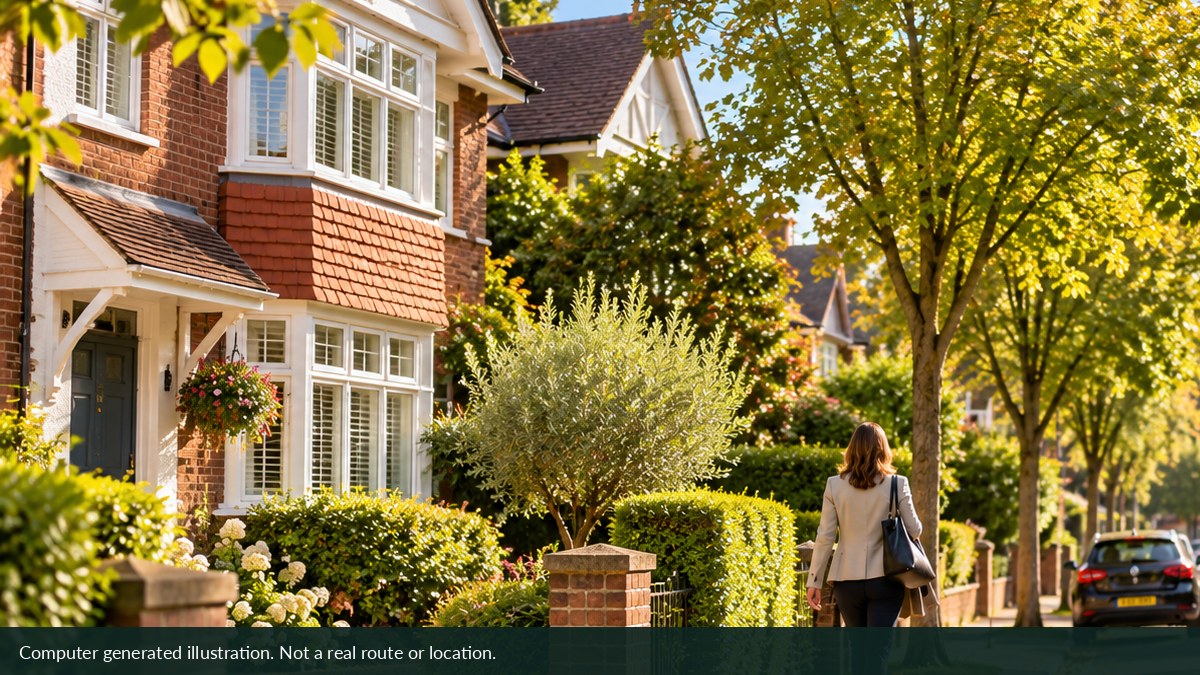
Park Langley Commuting: Comparing Your Station Options
Park Langley Commuting: Comparing Your Station Options
The best station for a Park Langley home is not necessarily the one closest on a map. Your destination, the route to the station, service pattern and return journey all affect which option works best.
Before using commuting convenience to choose a property, compare the complete trip from the front door to the place you need to reach. A quoted train time is only one part of it.
Which stations should you compare?
Depending on the address and destination, useful candidates include Eden Park, West Wickham, Beckenham Junction and Shortlands. They should be assessed as alternatives, not presented as equally convenient from every Park Langley house.
Use the official station information for the current facilities and the operator's journey planning tools for your intended dates and times. A route that looks attractive during one part of the day may operate differently at another.
Eden Park and West Wickham
Southeastern's pages for Eden Park station and West Wickham station provide practical station information. Compare the route to each from the actual property rather than treating them as interchangeable points on a line.
Include the time needed to reach the correct platform, not just the station entrance. Where a bus connection is involved, allow for the wait and the consequence of missing it.
Beckenham Junction and Shortlands
Review Beckenham Junction and Shortlands against your destination and preferred journey. Beckenham Junction also has a London Trams stop, which may be relevant to a different set of journeys.
A larger choice of connections is useful only if the route from home and the onward connection suit your day. Test that combination rather than assuming one station is universally better.
Where can the 352 bus be relevant?
TfL's published 352 route information includes stops serving locations such as Barnfield Wood Road Park Langley, Whitecroft Way, Hayes Way and Stone Park Avenue by the Chinese Garage. It also lists a stop at Red Lodge Road for West Wickham station.
That makes the route worth examining for some addresses. It does not establish the frequency, travel time or suitability of the stop nearest a particular house. Check the direction of travel and current timetable for the journey you intend to make.
A bus stop on a local map is a starting point for a journey plan, not proof of a convenient commute. Walk to the correct stop and consider the crossing and waiting arrangements.
How do you compare the complete journey?
Take two realistic departure times and record the same stages for each station option: leaving the house, reaching the station, waiting, travelling, changing where necessary and reaching the final destination.
Repeat the exercise for the return trip. The outward journey may be simple while the journey home involves a less frequent connection or an awkward wait. Include the occasional later finish as well as the ideal departure time.
A useful comparison also records cost and resilience. What happens when the usual route is disrupted? Is there a workable alternative, or would a missed connection create a major difficulty?
Use your working pattern, not someone else's
A person travelling five days each week may prioritise a different balance from someone attending an office twice a month. Flexible hours can also change which services are relevant.
Do not multiply a convenient sample journey into a promise about every weekday. Compare dates and times that resemble your actual commitments, including any fixed arrival time.
What about accessibility and carrying equipment?
Read the station's current accessibility information and contact the operator where a specific requirement matters. A station described broadly as accessible may still need closer examination of the route, platform arrangement or assistance needed for your journey.
The same applies to a pushchair, bicycle or heavy work equipment. Check the operator's conditions and consider the whole route through the station rather than assuming that reaching the entrance resolves the practical issue.
Where step free travel is essential, test the journey as a sequence of accessible stages. Temporary works or equipment faults can affect the experience, so check service information before travelling.
Can a viewing day test the commute properly?
It can provide part of the evidence. Walk the route from the property at a relevant time where possible, and notice junctions, lighting, gradients and the final approach to the station or bus stop.
A weekend viewing does not reproduce the working week. Nor does a journey on a bright afternoon establish how the route feels after dark. Use another visit where the decision depends heavily on travel convenience.
The important distance is the journey you will make, not the number that looks most attractive in a property description. An honest description should identify the station and the basis of any stated distance or time.
How should commuting affect a property decision?
Assess it alongside the accommodation, outside space and budget. A house with a slightly less direct journey may still be the right choice if it solves other important needs. A shorter commute may justify compromise elsewhere for a household travelling frequently.
The decision becomes easier when the trade off is explicit. Write down what you gain, what you give up and whether the alternative still works on an inconvenient day.
Integra-Estates can help arrange viewings and clarify which property specific questions need checking. Our Park Langley agency guide explains the importance of precise local information. Call 020 3870 00 00 to discuss the home and journeys that matter to you.
How much is your property worth?
Get your property valued by a local expert
Get A Valuation
-1.png)
.jpg)
.jpg)
.jpg)

Blogs
Loading photographs…
Let's Talk
If you want to discuss your property, plans for the future, or just want some friendly advice. There'll be no pressure, Just equal measures of common sense and expert advice to point you in the right direction.
Get In Touch